
Most ring advice starts with the stone. This one starts with you. A cut that photographs beautifully and never leaves the box is an expensive paperweight, and nobody mentions that at the counter.
Cut means two separate things, and the trade keeps them apart: the outline (round, oval, emerald, pear) and the facet style (brilliant, step, mixed). CIBJO’s Blue Book draws that line explicitly. What suits you depends on your hand, your clothes, and how much your hands actually do in a week.
Hand first, stone second
Look at your fingers straight on, not angled in a mirror.
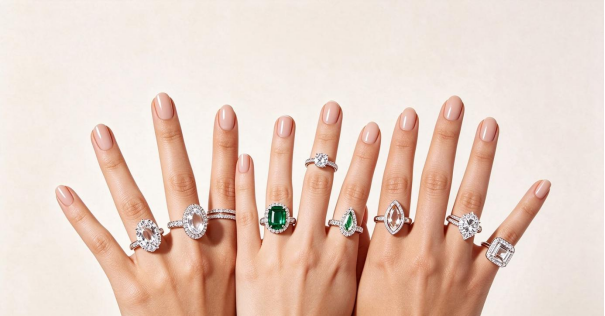
Short fingers read longer with an elongated outline: oval, marquise, a long cushion. The vertical line pulls the eye up the finger. Round and square outlines read wider, which flatters a long hand and works against a short one.
Knuckles matter too. A 1.5 carat oval on a size 4 finger covers most of the width; the same stone on a size 7 looks proportionate and slightly smaller. Carat is weight, not spread on the hand, and a chunky cut next to a spread cut can be most of a ring size difference.
What your clothes are already saying
Treat the jewelry as a set rather than a single purchase.
Delicate chains, thin bands, small studs: a step cut in a thin bezel continues that line. Bold cuffs and wide belts: a round brilliant in a six-prong setting holds its own next to them, while a small step cut disappears.
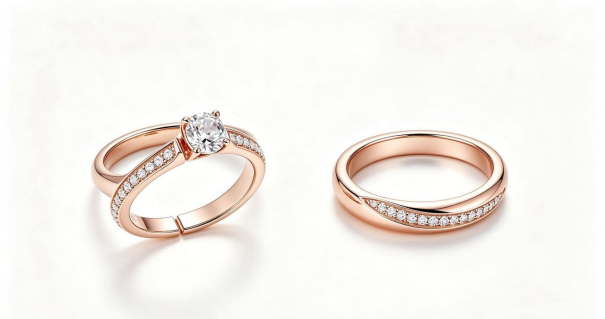
Metal tone changes the read. White metal pushes a near-colorless stone toward white and makes step-cut edges crisp. Yellow or rose pulls warmth out of the stone and softens the contrast between stone and setting, which flatters warmer colors and hides a slight tint better than white does.
Try both against your hand in daylight before deciding. Shop lighting is designed to sell. Daylight is designed to tell the truth.
Your week outvotes your taste
This is the part buyers skip, and it decides whether the ring comes off or stays on.
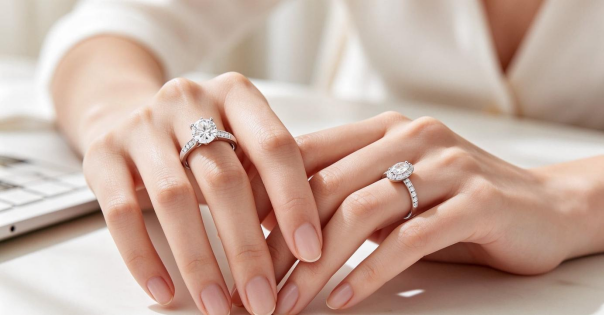
Hands that type all day: a high-profile setting catches on everything. Lower the stone, or bezel it.
Hands that lift, garden, cook, or work in gloves: a bezel protects the girdle. Girdles under 1.5 percent of the stone’s diameter are thin enough to chip during setting and ordinary wear, and a certificate noting a very thin girdle is a warning rather than a detail.
Hands that travel: a halo adds apparent size cheaply and reads well in photos, but it’s more surface to keep clean and more prongs to check.
Band width belongs here too. Around 1.8 to 2.2 mm is the range most people wear comfortably for decades; under 1.5 mm looks delicate in photos and starts to feel fragile once a stone over a carat is pushing weight onto a thin shank.
And think about the wedding band, because those two rings will share a finger for the rest of your life. A straight band next to a deep-set basket leaves a gap that collects lint and irritates anyone who notices detail. A contour band follows the profile and closes it.
Nails and hands age; the ring doesn’t. A cut you love at 30 is the one you’ll still wear at 50, which argues for the outline you actually find beautiful rather than the one trending this season.
Try the outline before you commit to it
Most people buy the shape they’ve seen most, not the shape that suits them. Try three outlines on your own hand in one visit: the one you came in wanting, the one the salesperson suggests, and the one you’d never pick. The third is usually the surprise. Photograph them and look at the images a day later, when the sales pressure has worn off.
Stacking changes the arithmetic. If you plan to wear a wedding band, an eternity band or a signet on the same finger, the widths add up. Three 2 mm bands already equal 6 mm of metal across the finger, which crowds a large stone on a small hand. Decide the stack before you decide the centre stone.
Three combinations that hold up
Oval in a four-prong solitaire with a plain band: the elongated outline does the work and the setting stays out of the way. Good for smaller hands.
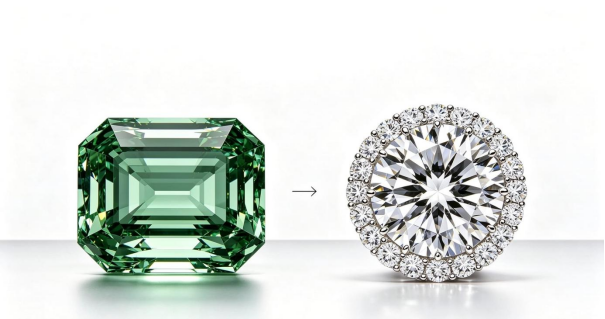
Emerald cut in a bezel on a slightly wider band: step facets show inclusions plainly, so this cut rewards buying a cleaner stone rather than a bigger one. In a bezel it also survives an active week.
Round brilliant in a low six-prong with a hidden halo: sparkle in any light, and the halo adds spread without adding height. The safest pick if you’re unsure.
Spread per carat is worth understanding before you fall for a number. An emerald cut carries more of its weight below the table, so a 1.5 carat emerald can look smaller than a 1.5 carat oval. If size on the hand is the goal, the elongated brilliant cuts give you more visible surface for the same money.
Maintenance is part of the match. A bezel setting needs little beyond an occasional polish, while a four or six prong setting wants a yearly check because prongs thin from the tip down and a lost stone is a much bigger repair than a tightened claw.
Where the report earns its keep
Brilliant cuts fragment the interior and hide small inclusions, so you can drop a clarity grade and put the money into cut quality. Step cuts do the opposite: big open facets show everything, so clarity is worth paying for.
The proportions block governs behavior, not just shape. Crown angle in GIA’s excellent range spans roughly 31.5 to 36.5 degrees, and two stones at opposite ends of that band don’t sparkle the same way even with identical labels.
What no certificate tells you is whether the ring suits your hand. That one you have to see.
If you want to compare outlines in the same setting before committing, our cushion cut page walks through how a softened square changes the light pattern next to a round brilliant.